 Hollywood Feed



Last Updated: November 1, 2026
Quick Summary
Litter odor control costs most households $220-$440 per year for odor-control clumping litter, while baking soda runs $35-$110 and carbon filters $55-$145. Litter itself is almost always the largest recurring cost, not the deodorizer, so compare options by cost per day rather than bag price.
- Odor-control clumping litter typically costs $0.60-$1.20 per day, or $220-$440 per year.
- Baking soda costs $35-$110 yearly but needs weekly top-ups and works only inside the litter.
- A passive air system costs about $0.83 per day, or roughly $300 per year.
- Stretching a full litter change from two weeks to four can swing annual cost by $100 or more.
- Divide any product's price by the days it covers, then multiply by 365 to compare fairly.
Table of Contents
- What Litter Odor Control Actually Costs Per Year
- Cost Comparison Table: Deodorizers, Litter, Baking Soda and Filters
- Finding the Best Litter Box Deodorizer for the Money
- Litter Box Deodorizer Without Baking Soda: What Changes
- Automatic Litter Box Odor Control: Hidden Costs of Self-Cleaning Boxes
- Multi-Cat Litter Box Odor Control: Cost Per Cat Scenarios
- Odor Control Per Dollar: Which Option Fits Your Household
- Build Your Own Odor Control Budget Before You Buy
- Frequently Asked Questions
What Litter Odor Control Actually Costs Per Year
Most cat owners budget for litter and forget everything else. Litter odor control is a recurring household expense that lives in four places: litter, deodorizer, filters, and cleaning supplies.
Litter odor control is the ongoing cost of managing smell at the box through litter choice, additives, filters, and air treatment, and most households underestimate it because they only count the bag of litter.
At MoodifyPet, we talk to multi-cat owners spending on three or four products at once and still fighting the smell. Here's where the money actually goes.
The Four Cost Buckets Most Owners Forget
- Litter replacement: the bag price times how often you dump the whole box, not just scoop.
- Deodorizer or additive: baking soda, litter additives, sprays, or a passive air system.
- Filters and hardware: carbon filters for hooded or automatic boxes, plus the electricity an automatic box draws.
A common mistake is comparing only bucket one. Two litters at the same bag price can cost very different amounts per year if one lasts twice as long.
Cost Comparison Table: Deodorizers, Litter, Baking Soda and Filters
A cost comparison only helps if it normalizes every option to the same unit. The table below converts each approach to a cost-per-day and cost-per-year range for a single-cat, single-box household, based on typical U.S. retail prices as of November 2026.
| Option | Where it works | Replacement rhythm | Typical unit price | Normalized cost per day | Normalized cost per year |
|---|---|---|---|---|---|
| Odor-control clumping litter | In the litter | Full change every 2-4 weeks; scoop daily | $18-$30 per 20-40 lb bag | $0.60-$1.20 | $220-$440 |
| Standard clumping litter | In the litter | Full change every 2-4 weeks; scoop daily | $12-$22 per 20-40 lb bag | $0.40-$0.90 | $150-$330 |
| Baking soda | In the litter | Weekly top-ups | $3-$6 per 1-2 lb box | $0.10-$0.30 | $35-$110 |
| Carbon filter | In the hood or box | Monthly | $5-$12 per filter | $0.15-$0.40 | $55-$145 |
| Automatic box (consumables only) | At the box | Liners weekly, filters monthly, power ongoing | $15-$30 per liner roll; $5-$12 per filter | $0.50-$1.10 | $180-$400 |
| Passive air system | In the air | Every 30 days | $24.99 per unit | $0.83 | $300 |
Three things jump out. Litter itself is almost always the largest recurring line item, not the deodorizer. Baking soda looks cheapest per day but requires weekly labor and works only inside the litter, so it does not address air odor. A passive air system lands in the same per-day range as premium odor-control litter while targeting the air around the box rather than the litter surface.
For the deeper head-to-head on filters versus litter additives, our breakdown of charcoal filter vs litter deodorizer covers where each one actually works and which setup fits your home.
How Replacement Frequency Changes the Math
The biggest variable in any cost comparison is how often you fully change the litter, not just scoop it. A household that scoops twice daily and tops off litter can stretch a full change to three or four weeks; one that scoops once a day, or has a cat that digs to the bottom, may need a full change every 10-14 days.
Use these assumptions when you run your own numbers:
- Scooping: twice daily is the common recommendation from veterinary sources; once daily is the realistic minimum for most households.
- Full change: every 2-4 weeks for clumping litter, more often in multi-cat homes or with non-clumping litter.
- Litter depth: 2-3 inches is typical; deeper litter means more volume per change and higher cost.
State your assumptions out loud before you compare products. A $30 bag that lasts four weeks can be cheaper per year than a $20 bag that lasts two weeks.
Where the Hidden Costs Hide
Delivery fees, liners, disposal bags, and enzyme cleaners rarely appear in a bag-price comparison, but they are real recurring costs. A hooded box needs filters, an automatic box needs liners and power, and a multi-cat home burns through enzyme cleaner faster. Add those to your annual number before deciding which deodorizer is the best value.
Finding the Best Litter Box Deodorizer for the Money
The best litter box deodorizer for the money is the one that keeps working between replacements without daily effort. Price per unit matters less than cost per day of coverage; a cheap product you reapply twice a week often costs more per month than a passive system you replace once.
Here's how we'd judge any deodorizer before buying:
- Does it work in the litter or in the air? In-litter products need mixing; air products need placement.
- How often do you replace it? Daily and weekly products add up quietly.
- Does it need power or batteries? Those are hidden ongoing costs.
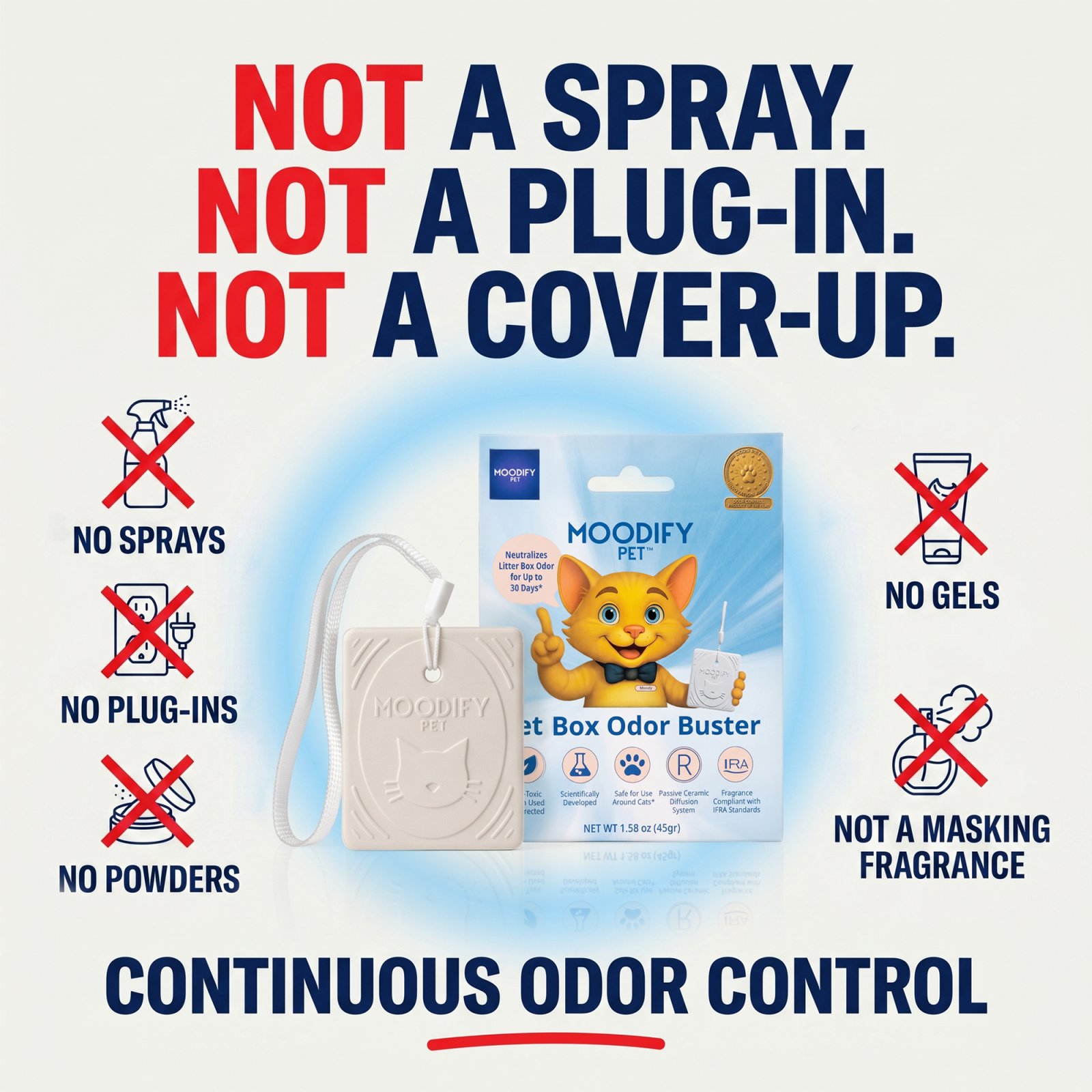
Our premium ceramic passive system is designed to work in the surrounding air, not in the litter, and runs up to 30 days per unit with no sprays, powders, or electricity. That predictable replacement rhythm makes the annual math simple.
Litter Box Deodorizer Without Baking Soda: What Changes
A litter box deodorizer without baking soda changes two things: no weekly top-ups and no moisture-sensitive powder to manage. Baking soda is cheap per box, but it needs frequent reapplication, and it works inside the litter where clumping and moisture affect how well it performs.
Baking soda does have a place. It's a low-cost option for a single box with light odor. Where it falls short is multi-cat homes and hooded boxes, where the smell escapes the litter and hangs in the air around the box.
A passive air system takes a different route. Instead of absorbing moisture in the litter, it works on odor in the surrounding air, which is where the smell actually reaches your nose.
Automatic Litter Box Odor Control: Hidden Costs of Self-Cleaning Boxes
Automatic litter box odor control solves scooping, not smell. A self-cleaning box still holds waste in a compartment, and that compartment produces odor between empties.
The upfront price of an automatic box is the visible cost. The ongoing costs are the liners and filters you reorder, plus the power draw.
That's where a passive system complements an automatic box rather than competing with it. Our guide to passive litter odor control explains how these systems fit into a self-cleaning setup.
Multi-Cat Litter Box Odor Control: Cost Per Cat Scenarios
Multi-cat litter box odor control is where budgets break, because odor scales faster than the number of cats. Each cat adds litter volume, more frequent full changes, and more air odor to manage.
Run the math per cat:
- One cat, one box: one litter supply, one deodorizer unit per 30 days.
- Two cats, two boxes: roughly double the litter and two air-coverage points.
- Three or more cats: litter changes speed up, and air odor needs coverage across the room, not just at one box.
The mistake is buying one deodorizer for a four-cat home and expecting it to cover every box. For a step-by-step plan, our guide on managing multi-cat odors walks through the routine that keeps a busy household livable.
Odor Control Per Dollar: Which Option Fits Your Household
Most cost comparisons treat price and odor control as separate columns. The useful number is odor control per dollar, how much odor relief you get for each dollar you spend per day, and almost no ranking article calculates it. Here is a transparent way to do it yourself.
A Simple Odor-Per-Dollar Scoring Method
Score each option from 1 to 5 on three factors, then divide by its cost per day. The factors are:
- Coverage (1-5): does it work in the litter, in the air, or both? Air coverage scores higher in hooded boxes and open rooms because that is where odor reaches your nose.
- Persistence (1-5): how long does one application or unit last before you must replace or reapply? Daily and weekly products score lower because the cost and labor repeat.
- Effort (1-5): how much daily attention does it require? Passive products score higher; sprays and powders score lower.
Add the three scores, then divide by cost per day. A higher number means more odor relief per dollar.
| Option | Coverage | Persistence | Effort | Total score | Cost per day | Score per dollar |
|---|---|---|---|---|---|---|
| Odor-control litter | 3 | 3 | 4 | 10 | $0.60-$1.20 | 8-17 |
| Baking soda | 2 | 2 | 2 | 6 | $0.10-$0.30 | 20-60 |
| Carbon filter | 3 | 3 | 4 | 10 | $0.15-$0.40 | 25-67 |
| Automatic box consumables | 3 | 3 | 5 | 11 | $0.50-$1.10 | 10-22 |
| Passive air system | 4 | 4 | 5 | 13 | $0.83 | 16 |
The scores are illustrative, not lab measurements, but the pattern is useful. Baking soda and carbon filters score high per dollar because they are cheap, but they cover less of the actual odor problem, especially air odor in hooded boxes and multi-cat rooms.
MoodifyPet Cat Litter Box Odor Neutralizer — 12 Pack (Max Coverage) →
Matching the Option to the Household
Odor control per dollar favors the option that matches your household's actual odor load. A single quiet cat and a four-cat apartment are different problems, and the cheapest product for one is rarely the cheapest for the other.
- Single cat, one box, light odor: standard clumping litter plus a low-cost in-litter option is usually enough. Cost per day stays low and effort is minimal.
- Single cat, hooded box or small apartment: air odor accumulates even with good scooping. A passive air system with room coverage, replaced monthly, keeps the cost predictable and addresses the air the box cannot.
- Two to three cats: litter volume and full-change frequency both rise. Pair odor-control litter with air coverage sized to the room, not just the box.
Cost Per Cat, Not Cost Per Household
Multi-cat households should calculate cost per cat, because odor scales faster than the number of cats. A two-cat home does not simply double the litter bill, it often doubles the full-change frequency as well, which compounds the annual cost.
Run the math per cat:
- One cat, one box: one litter supply, one air-coverage point per room-sized zone.
- Two cats, two boxes: roughly double the litter and two air-coverage points if the boxes are in different rooms.
- Three or more cats: litter changes speed up, and air odor needs coverage across the room, not just at one box.
The mistake is buying one deodorizer for a four-cat home and expecting it to cover every box. Coverage should match the space and the number of litter areas.
When you divide a passive system's cost across a month of continuous coverage, the per-day figure is small and fixed, which makes it easy to budget. The 12-pack odor neutralizer delivers a full year of coverage for a single box at the lowest per-unit price, with Subscribe & Save available for automatic replacements.

Build Your Own Odor Control Budget Before You Buy
Build your odor control budget before you buy anything, because the cheapest-looking product is often the most expensive per year.
Use this checklist to set your monthly number:
- Count your cats and litter boxes.
- Note how often you do a full litter change, not just scooping.
- Add any filter or liner replacements your box needs.
Before you commit, check the shipping and returns details so your budget includes delivery and the money-back guarantee. Then pick the pack size that matches your home and set a monthly reminder to replace it on schedule.
The real challenge isn't finding a cheaper product. It's finding one that keeps working between replacements without daily effort.
Frequently Asked Questions
What is the cheapest way to control litter box odor?
Plain scooping twice daily plus an unscented clumping litter is the lowest cash outlay, since you are not buying a second product. The trade-off is labor and a weaker result in multi-cat homes. Baking soda is inexpensive per box but needs frequent reapplication. A single MoodifyPet system is $24.99 for up to 30 days, roughly 83 cents a day.
How much does it cost to deodorize a cat litter box each month?
Budget depends on method. Baking soda runs a few dollars a month per box but requires reapplying after every scooping session. Carbon filters for hooded or automatic boxes typically need replacement monthly. A single MoodifyPet system is $24.99 for up to 30 days of coverage, and multi-packs lower the per-unit price: the 3 pack is $74.97, the 6 pack is $127.49 and the 12 pack is $239.78 for a full year of single-box coverage.
Is litter deodorizer or odor-control litter more cost-effective?
Odor-control litter usually costs more per pound than plain clumping litter, and you pay that premium on every bag, all year. A separate deodorizer lets you keep a cheaper litter and add odor control only where you need it. Run the math on your own bag size and replacement frequency to compare the annual cost of each option.
Does baking soda actually help control cat litter odor?
Baking soda absorbs some odor inside the litter, which is why so many deodorizers include it. It works best as a fresh layer and loses effectiveness as the box is used, so it needs regular reapplication. It also does nothing for odors already in the air around the box. If you want to skip the dust and the repeat sprinkling, a litter box deodorizer without baking soda that works in the surrounding air is the alternative to compare.
Are carbon filters worth it for litter box odor control?
Carbon filters capture some odor as air passes through a hood or automatic box, so they help most when the box is enclosed. They only treat air that moves through the filter, and they need monthly replacement to keep working. Compare the annual filter cost against your household's odor needs before deciding which option fits.
