Available in 200+ pet shops nationwideHollywood FeedHollywood Feed
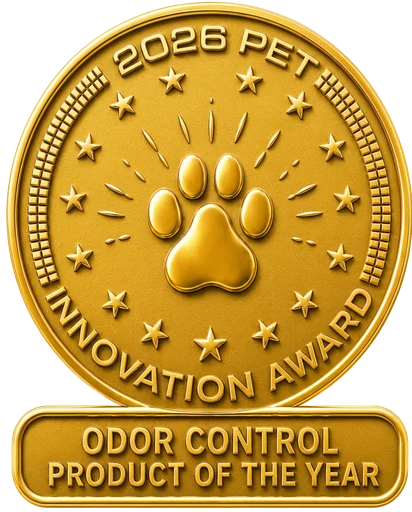
MoodifyPet Named 2026 Pet Innovation Award Winner — Odor Control Product of the YearLearn more →

How MoodifyPet Actually Works — and Why It’s Safe

We know it’s strange to trust a small ceramic tile to clear the air. Here’s the real science behind it, explained simply — including who makes the formula and why it’s built to be safe around cats, kids, and you.

Who’s actually behind the formula

MoodifyPet’s odor-neutralizing formula is developed based on 100 years of experience and decades of dedicated research specifically in malodor science, at the intersection of chemistry, biology, and sensory science. Every batch is manufactured to IFRA’s international safety standards.

The simple science

Three steps, no jargon — here’s what’s actually happening in the air around the litter box.

  1. Step 1

    Odor molecules float into the air

    When waste breaks down in the litter box, it releases tiny invisible gas molecules — mostly ammonia and sulfur compounds. These are what you smell as “litter box smell.” They spread into the room the same way any smell does.

  2. Step 2

    A fragrance-grade catalyst goes to work

    The ceramic pendant slowly releases specially engineered active ingredients into the air around it. These ingredients are designed to chemically attach to odor molecules — not cover them up.

  3. Step 3

    The odor is changed into something with no smell

    Once attached, the odor molecule is chemically converted into a new, odorless compound. Nothing is masked with perfume — the original bad-smelling molecule simply stops being able to trigger your nose’s odor receptors.

In fragrance science this is sometimes called olfactory white or odor neutralization — changing how a smell is perceived at the molecular level rather than covering it with a stronger scent. It’s a well-documented area of peer-reviewed olfactory science.

Is it safe for my cat, my kids, and me?

No. The pendant is a sealed, passive ceramic — nothing is sprayed, heated, or aerosolized. The active ingredients release slowly and in very small amounts, the same way a scented candle or air freshener releases scent — except here there’s no flame and no propellant.

Built on established fragrance science, not a gimmick

Odor neutralization research. Changing how a smell is perceived at the molecular level — rather than covering it with a stronger competing scent — is a well-documented area of peer-reviewed olfactory science, sometimes referred to as olfactory white. Carefully engineered combinations of odor-active molecules can change how a target smell registers in the nose, instead of simply piling perfume on top of it.

AI-assisted fragrance design. The fragrance industry increasingly uses predictive, AI-assisted tools in its malodor R&D — computational and machine-learning methods that estimate how a molecule or mixture will smell before it’s physically tested. IBM’s patented method (US 11,062,216 B2, “Prediction of Olfactory and Taste Perception Through Semantic Encoding”) is one public example, modeling scent descriptors from molecular and language data. It’s cited here only as general background on how modern fragrance science is developed — not as a description of MoodifyPet’s specific formula.

Note: MoodifyPet’s exact formula is a proprietary formulation not publicly disclosed. This page explains the general scientific principles the category of technology is built on. The IBM patent is cited only as an example of how AI is used in fragrance science generally.

Curious how it performs in real multi-cat homes?

See multi-cat results