 Hollywood Feed

Last Updated: October 25, 2026
Quick Summary
A charcoal filter and a litter deodorizer solve two halves of the same problem. A litter deodorizer works inside the box on the litter itself to reduce odor at the source, while a charcoal filter adsorbs odor molecules from air passing through it. Neither replaces daily scooping, and both work best together.
- A carbon filter belongs in the hood, lid vent, or filter slot where moving air reaches it.
- Most makers recommend swapping carbon filters every two to four weeks, per label and cat count.
- Deodorizer dosing is tied to scooping and full litter changes, with pods and pads often lasting two to four weeks.
- Start with litter-side control if the box smells at scoop time, then add air-side control if the room still carries odor.
- Skip DIY charcoal additions, since loose carbon dust is messy and offers little benefit once coated.
Table of Contents
- Charcoal Filter vs Litter Deodorizer: The Short Answer
- How Charcoal Filters and Litter Deodorizers Control Odor
- Side-by-Side Comparison: Cost, Lifespan, and Upkeep
- Activated Charcoal Cat Litter: Does Mixing It In Help?
- Automatic Litter Box Odor Control: Filter Placement and Compatibility
- Litter Box Deodorizer Without Baking Soda: What to Look For
- Cat Litter Smell in an Apartment: When Air-Based Control Makes Sense
- Safety, Dust, and Fragrance Sensitivity
- The Verdict: Which Should You Buy?
- Frequently Asked Questions
Charcoal Filter vs Litter Deodorizer: The Short Answer
A charcoal filter and a litter deodorizer solve two halves of the same problem. A carbon filter traps odor molecules rising off the litter and passing through it. A litter deodorizer works inside the box, on the litter itself, to reduce odor at the source.
If the box smells fine up close but the room still carries a whiff, you need air-side control. If it reeks the moment you scoop, start with litter-side help.
A litter deodorizer is added to or used around cat litter to reduce urine and fecal odor; a charcoal filter is a porous carbon pad that adsorbs odor molecules from air passing through it.
Neither option is a full solution on its own.
How Charcoal Filters and Litter Deodorizers Control Odor
Charcoal filters and litter deodorizers attack odor at different points in the same chain: molecules leave the litter surface, travel through the air, and reach your nose. A deodorizer intercepts them inside the box; a filter catches whatever escapes.
Adsorption vs Absorption: Why the Distinction Matters
Adsorption is when molecules stick to a material's surface, which is how activated carbon works.
Activated carbon is treated to create millions of tiny pores, and odor molecules in passing air stick to those surfaces.
Litter deodorizers take a different route. Some use plant-based additives that bind odor compounds in urine.
A carbon filter placed where litter dust and moisture hit it directly will clog well before its rated life.
Where Each Method Sits in the Litter Box Area
Placement decides whether either method does anything.
A litter deodorizer goes where the waste is: mixed into litter, sprinkled in the base of the pan, or used as a liner pad. Pods beside the box are closer to air care than litter care.
That leaves a gap. You can read more on how litter odor travels through a room and where an air-based eliminator works.
Side-by-Side Comparison: Cost, Lifespan, and Upkeep
Cost and upkeep separate these methods more than raw performance. A carbon filter is inexpensive per unit but needs frequent swapping; a litter deodorizer is a recurring consumable tied to litter changes. Budget both as ongoing supplies alongside litter.
Replacement Schedules in Practice
Manufacturer instructions vary, so always follow the label. That said, a few patterns hold across most setups:
- Carbon filters in covered boxes: Most makers recommend swapping every two to four weeks. In a single-cat household with a hooded box, many owners get close to the longer end. In a multi-cat home or a humid bathroom, expect the shorter end.
- Carbon filters in automatic boxes: Follow the unit's schedule, which is usually every two to four weeks depending on the model and how many cats use it. The waste drawer stays closed and humid, which loads the filter faster than an open hood.
- Litter deodorizers: Dosing is tied to scooping and full litter changes. Powders and mixes are typically added at each full change, and some brands suggest a refresh at scooping. Pods and pads have their own stated life, often two to four weeks.
A common mistake is expecting one carbon filter to last a season. In a busy multi-cat box, filters load up with dust and moisture and lose effectiveness well before the packaging suggests. If dust cakes the pad or you smell the box through the hood, it's done.
MoodifyPet Cat Litter Box Odor Neutralizer — 1 System for 30 Days →
How to Estimate Monthly Cost Without Guessing
Prices swing by brand, pack size, and retailer, so compare your options on equal footing:
- Find the per-unit cost on the product page (pack price divided by the number of filters or doses).
- Divide by the realistic replacement interval for your household, not the best-case one. A two-week filter in a two-cat home means roughly two filters a month.
- Multiply by your cat count factor. One cat is the baseline; each additional cat typically shortens filter and deodorizer life because there's more waste and more humidity.
- Add the litter cost separately. Odor-control litter bundles the deodorizer into the litter price, so compare it against regular litter plus a standalone deodorizer.
The pattern becomes obvious: carbon filters are cheap per unit but add up with frequency, while deodorizers are cheap per dose but scale with litter changes. Both climb in a multi-cat home.
Upkeep Beyond Replacement
Both methods also need attention between swaps:
- Carbon filters: Check for dust clogging and moisture. Don't rinse and reuse; a wet filter loses its edge fast. Keep it on the air path, not in the litter.
- Litter deodorizers: Mix evenly rather than dumping in one corner, and watch for clumping or texture changes cats may reject. Refresh after a full litter change, not just at scooping.
- Both: Neither replaces daily scooping, full litter changes, or box washing. If you skip those, no filter or deodorizer will keep up.
| Factor | Charcoal Filter | Litter Deodorizer |
|---|---|---|
| Where it works | Air passing through the filter | Litter and waste in the pan |
| Typical replacement | Every 2-4 weeks, per label and cat count | Tied to litter changes; pods/pads often 2-4 weeks |
| Cost pattern | Low per unit, frequent swaps | Low per dose, scales with litter changes |
| Upkeep | Swap on schedule, check for dust clogging | Mix evenly, refresh at changes, watch cat acceptance |
| Best for | Covered and automatic boxes | Boxes that smell at scoop time |
| Weak spot | Does nothing for odor already in the room | Can add dust or scent some cats dislike |
| Cat acceptance risk | Low, no contact with litter | Varies by texture and fragrance |
Activated Charcoal Cat Litter: Does Mixing It In Help?
Activated charcoal cat litter and charcoal-blend litters help modestly.
Carbon works best on moving air with low humidity. Buried in clumping litter, it's mostly coated in dust and moisture within days.
For air-side work, a filter in the hood or vent is the better placement.
Skip DIY charcoal additions. Loose carbon dust is messy, cats track it, and the black dust shows up on paws and floors.
Automatic Litter Box Odor Control: Filter Placement and Compatibility
Automatic boxes need odor control that doesn't interfere with the mechanism. Most units have a dedicated carbon filter slot in the waste drawer or hood.
Automatic litter box odor control has one extra problem: the waste drawer sits closed for hours, and odor builds in that sealed space.
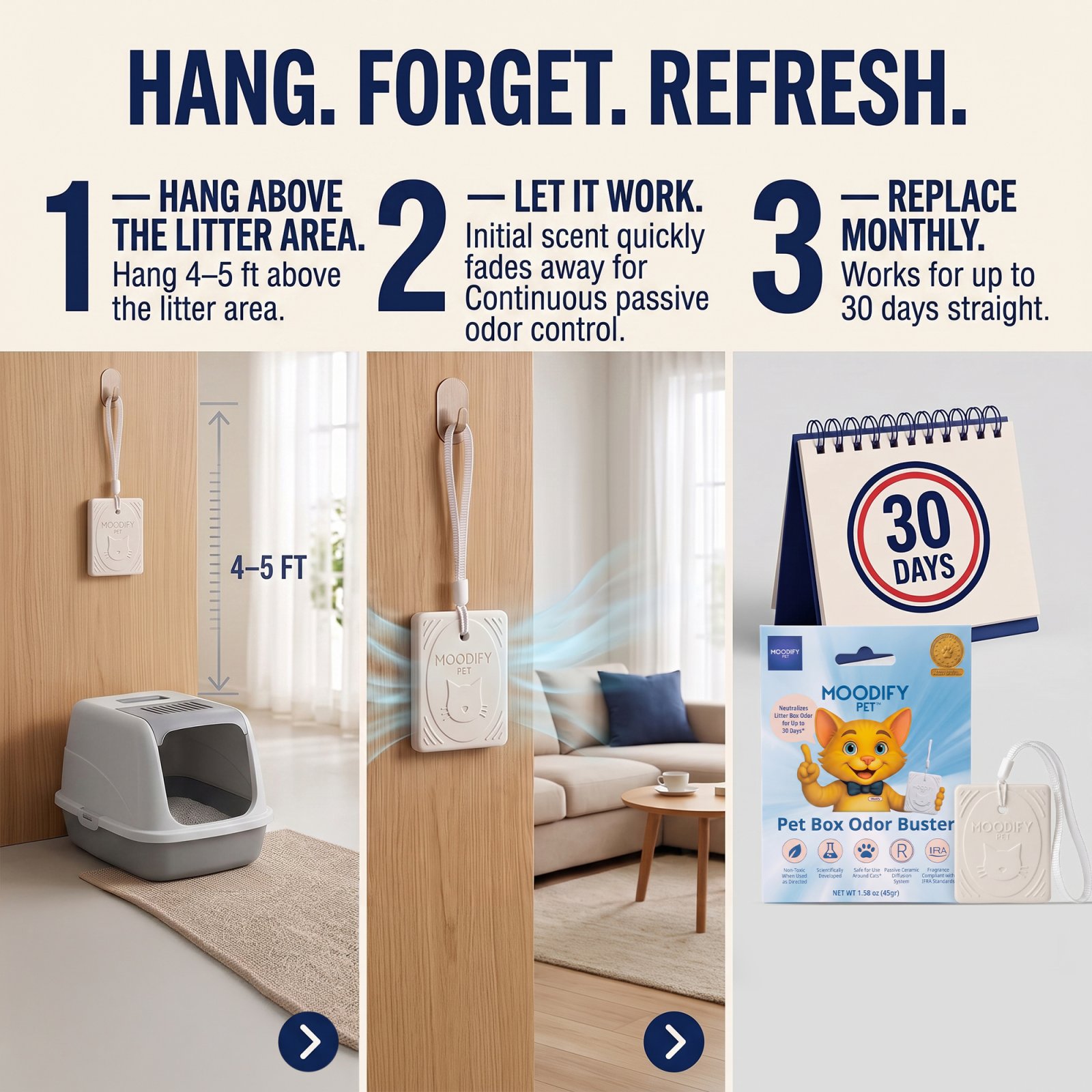
For the air around the unit, a passive system that hangs above the box and never touches the litter or the mechanism is the safest add-on. Our ceramic pendant works by neutralizing odor in the surrounding air, which keeps it clear of sensors, rakes, and moving parts.
Best for: covered boxes, automatic units, and rooms where the box odor lingers after scooping. Skip if: the box itself smells strongly at scoop time.
Litter Box Deodorizer Without Baking Soda: What to Look For
A litter box deodorizer without baking soda suits cats and owners who react to dust or scent. Baking soda is common and generally safe, but it's fine and dusty, and some cats object to the texture change.
Look for these traits instead:
- Low-dust formulas. Fine powders coat paws and floors.
- Unscented or lightly scented options. Strong fragrance bothers sensitive cats and people.
- Non-toxic ingredients. Check for a full ingredient list, not just "natural."
If you're comparing safe, non-toxic options before buying, our guide to non-toxic litter box deodorizers breaks down what to check on the label.
Cat Litter Smell in an Apartment: When Air-Based Control Makes Sense
Cat litter smell in an apartment concentrates faster because there's less air volume and often poor cross-ventilation. A box in a closet or bathroom has nowhere for odor to go.
That's where air-based control earns its place. You can scoop perfectly and still get a lingering smell in a studio or one-bedroom, because odor has spread into soft furnishings and settled air.
A passive neutralizer hung four to six feet above the litter area works on the room air instead. For a fuller set of apartment-specific steps, see our guide to eliminating litter box odor in a small apartment.
Safety, Dust, and Fragrance Sensitivity
Safety comes down to contact and ingredients. Carbon filters are inert and low-risk as long as cats can't chew them and they don't shed dust into the litter. Litter deodorizers carry more variables: dust, fragrance, and ingestion risk if a cat licks paws after walking through treated litter. Neither is dangerous when used as directed, but both deserve a closer look.
MoodifyPet Cat Litter Box Odor Neutralizer — 1 System for 30 Days →
Charcoal Dust and Ingestion
Activated carbon itself isn't toxic, but loose charcoal dust is a nuisance: fine black dust settles on paws, floors, and nearby surfaces, and grooming cats may ingest a little. The bigger risk is a cat chewing a filter pad or loose charcoal packet, which can cause choking or gastrointestinal upset.
Practical steps:
- Keep filters enclosed. Use the manufacturer's slot or housing so the pad isn't accessible to paws or teeth.
- Skip DIY charcoal additions. Loose carbon mixed into litter is messy, tracks onto floors, and offers little benefit once it's coated in dust and moisture.
- Watch for dust shedding. If a filter is crumbling or shedding, replace it rather than handling it further.
If a cat does eat charcoal or filter material, contact your veterinarian. Activated carbon is used in some veterinary settings, but that doesn't make a chewed filter a do-it-yourself situation.
Deodorizer Dust, Texture, and Ingestion
Litter deodorizers vary widely. Powders can be fine and dusty, coating paws and floors, and some cats object to the texture change and start avoiding the box, a bigger problem than the odor you were trying to fix.
What to check before buying:
- Full ingredient list. Look for a complete list, not just "natural" or "plant-based."
- Low-dust formula. Fine powders are the most likely to coat paws and get tracked.
- Unscented or lightly scented. Strong fragrance bothers sensitive cats and people.
If you're comparing safe, non-toxic options before buying, our guide to non-toxic litter box deodorizers breaks down what to check on the label.
Fragrance Sensitivity in Cats and People
Fragrance sensitivity matters for both cats and people. Cats have a far stronger sense of smell than we do, and a scent that reads as fresh to you can be overwhelming to them.
If you or your cat react to sprays and plug-ins:
- Choose unscented litter-side products.
- Prefer air-side options that don't rely on heavy fragrance.
- Introduce any scented product in a small area first and watch for reactions.
One note on expectations: with any fragrance-infused product, the scent may fade after the first day or two. That doesn't mean odor control has stopped. Judge performance by whether the room smells better, not by whether you can still detect the fragrance.
Safe Placement for Air-Side Products
Air-side products should never contact cats or litter. A passive neutralizer hung four to six feet above the litter area stays out of reach and out of the box, clear of paws, sensors, rakes, and moving parts in automatic units. That placement also puts it in the air where odor actually travels, rather than buried in wet litter where carbon and deodorizers lose effectiveness fast.
The Verdict: Which Should You Buy?
Buy both, in the right order. Start with litter-side control if the box smells at scoop time, then add air-side control if the room still carries odor.
That's the gap a passive air-based neutralizer fills. Each unit lasts up to 30 days, and the Classic 2 Pack covers about 60 days across a litter space.

If you've tried filters, deodorizers, and every spray on the shelf and the room still smells, the missing piece is usually air-side control.
Frequently Asked Questions
Does regular charcoal absorb litter box odors?
Plain charcoal does adsorb some odor molecules, but only where air actually passes through it. A bag of charcoal sitting on a shelf has very little contact with moving air, so its effect is limited. Activated charcoal is processed to open millions of tiny pores, which gives it far more surface area per gram. Even then, a filter only treats the air that reaches it, so placement near the litter box and airflow through the room matter as much as the material itself.
Can a litter deodorizer work without being mixed into the litter?
Yes. Air-based litter deodorizers and neutralizers are designed to work on the surrounding air rather than inside the box. MoodifyPet, for example, hangs 4-6 feet above the litter area and is designed to cover up to 500 sq ft per litter space, with no contact between the unit and the litter or your cat. These products supplement scooping and litter changes; they do not replace them. Mix-in deodorizers work inside the litter, so the two approaches address different parts of the problem.
Which litter deodorizer is best for a multi-cat home?
The right pick depends on where the smell is coming from. If odors are rising from the litter itself, a mix-in deodorizer or an odor-control litter helps. If the smell has spread into the room, an air-based neutralizer covers more ground. Multi-cat homes often need both plus more frequent scooping. MoodifyPet's 3 Pack is sized for 2-3 cat households, covering up to three boxes for 30 days or one box for 90 days.
Do you need an odor trap for an automatic litter box?
Automatic boxes cycle waste into a sealed drawer, which reduces odor but does not eliminate it. The drawer, the globe, and the exit opening all release odor into the room between cycles. An odor trap or air-based neutralizer placed above the unit handles that ambient smell. Check that any add-on does not block the box's sensors or entry. MoodifyPet hangs above the litter area without touching the unit, so it stays compatible with automatic boxes.
How often do charcoal filters and litter deodorizers need replacing?
Carbon filters typically need replacing every two to four weeks depending on the manufacturer and how many cats you have. Mix-in deodorizers last as long as the litter, usually one to two weeks per change. Passive air neutralizers like MoodifyPet are replaced every 30 days per unit for continuous coverage. Budgeting by the month rather than the unit makes comparisons easier, since a cheap filter replaced twice as often can cost more than it first appears.
