 Hollywood Feed


Last Updated: October 28, 2026
Quick Summary
The best air purifier for multiple cats combines True HEPA filtration for dander and hair with a substantial activated carbon stage for ammonia and litter odor, plus a washable pre-filter. Match its CADR to each litter room's volume and aim for four to five air changes per hour.
- Three-stage filtration matters: pre-filter, True HEPA, and activated carbon each handle a different pollutant.
- A HEPA filter does not stop ammonia and other odor gases; only an adsorbent stage does meaningful work there.
- Calculate air changes per hour as CADR in cubic feet per minute times 60, divided by room volume.
- Use one purifier per litter room when boxes are spread across separate rooms or doorways stay closed.
- Scoop twice daily and keep one box per cat plus one, spread across at least two rooms.
Table of Contents
- What the Best Air Purifier for Multiple Cats Actually Needs to Do
- An Air Purifier for Litter Box Odor: What It Can and Cannot Fix
- Air Purifier for Cat Dander: Filtration Stages That Matter
- Sizing by Room, Airflow, and Air Changes Per Hour
- Multi-Cat Litter Box Odor Control: A Room-by-Room Plan
- Cat Litter Smell in an Apartment: Small-Space Strategy
- Total Cost of Ownership and What to Check Before Buying
- Build Your Multi-Cat Odor Plan Before You Buy a Purifier
- Frequently Asked Questions
What the Best Air Purifier for Multiple Cats Actually Needs to Do
The best air purifier for multiple cats removes both airborne particles and odor-causing gases, cycles a room's air several times per hour, and stays quiet enough that cats ignore it. A purifier is one layer of odor control, not the whole plan.
Multiple cats produce more dander, tracked litter dust, and ammonia vapor. A three-cat household exposes every shortcut in a purifier's design.
Here is the short answer on what to look for:
- True HEPA filtration for pet hair, dander, and fine particulate matter
- A substantial activated carbon stage for gases, not a thin carbon dusting
- A washable pre-filter that catches hair before it clogs the HEPA layer
Particles, gases, and why one filter stage is not enough
Cat-related air pollution comes in two forms, and they need different filters. Pet hair and cat dander are particles. Litter box odor is mostly gas.
Dander is the protein-rich skin shedding that triggers most cat allergy symptoms, and it rides on particles small enough to stay airborne for hours.
Odor is chemistry. Urine breaks down into ammonia and other volatile compounds that behave like gases, not dust. A HEPA filter does not stop them.
That is why three-stage filtration matters: pre-filter, True HEPA, activated carbon. If you are weighing filter stages against in-litter products, our breakdown of charcoal filter vs litter deodorizer covers where each one actually works.
An Air Purifier for Litter Box Odor: What It Can and Cannot Fix
An air purifier for litter box odor can reduce odor compounds that have already become airborne and drifted into the room.
That distinction matters most in multi-cat homes: a purifier across the room pulls in diluted air, while the strongest odor sits at the litter surface.
What a purifier does well:
- Pulls odor molecules out of the room air as they circulate
- Captures litter dust that carries odor with it
- Keeps a baseline of cleaner air in the room between scoopings
What it does not do:
- Neutralize odor at the source inside the litter
- Replace scooping, full litter changes, or box cleaning
- Fix a box that is overdue for a wash
The practical takeaway: pair a purifier with a source-level routine and an air-level product.
Air Purifier for Cat Dander: Filtration Stages That Matter
An air purifier for cat dander works only if it uses True HEPA filtration and moves enough air through that filter to cycle the room. Dander particles are small, sticky, and persistent, and weak airflow leaves them suspended.
Cat dander is the top driver of allergy symptoms in cat households. It settles on surfaces and gets kicked back into the air whenever a cat jumps off a shelf.
HEPA, carbon, and the pre-filter layer explained
True HEPA is a filter rating, not a marketing word. It describes a filter tested to capture a very high percentage of particles at the most penetrating particle size.
Activated carbon adsorbs gases and odors, and quality varies enormously: a thin carbon pad lasts weeks, a heavier bed lasts months.
The pre-filter catches hair, lint, and large litter dust before they reach the HEPA media.
Sizing by Room, Airflow, and Air Changes Per Hour
Room size and airflow decide whether a purifier keeps up, and most buyers size wrong.
Air changes per hour (ACH) is the metric that matters: how many times per hour the purifier moves a room's worth of air through its filters.
You can estimate ACH yourself with one formula:
ACH = (CADR in cubic feet per minute × 60) ÷ room volume in cubic feet
Room volume is length × width × ceiling height. A 12 ft × 14 ft room with 8 ft ceilings is 1,344 cubic feet.
CADR, or clean air delivery rate, tells you how much filtered air the unit delivers.
Shop Now — $24.99 →
One unit or several? A floor-plan decision
The answer depends on how your rooms connect, not just total square footage.
- One high-capacity unit is enough when the litter boxes sit in a single open space and the purifier can be placed within a few feet of the boxes with clear airflow. A studio, a finished basement, or a single dedicated cat room fits this pattern.
- Plan for two or more units when litter boxes are spread across separate rooms, when doorways stay closed, or when the home has a long hallway that breaks airflow. Air does not respect room boundaries the way product specs do.
- Treat connected spaces as one big room when a kitchen, dining area, and living room flow together without doors. Size for the combined volume, or place a unit in each zone.
A two-bedroom apartment with one box in a bathroom and one in a hallway closet needs air treatment in both spots.
Placement rules that decide real-world performance
- Put the unit where air actually moves, not behind a sofa or in a corner.
- Keep at least a foot of clearance around intakes so the unit can pull air freely.
- Place the purifier between the litter area and the rest of the room when possible, so odor-laden air passes through the filter before spreading.
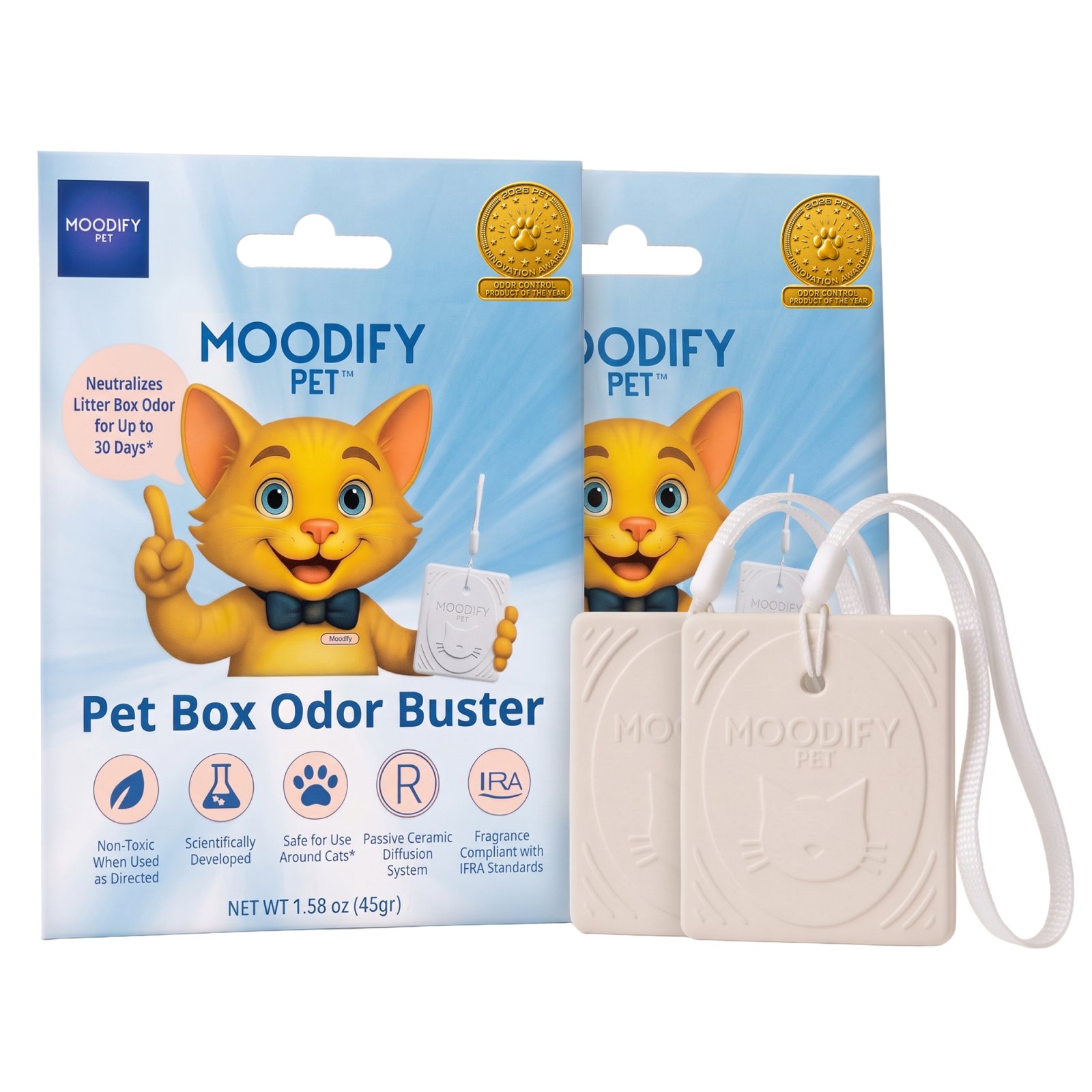
For litter areas specifically, pair the purifier with an air-level product. A passive system like the MoodifyPet premium ceramic passive system hangs four to six feet above the litter area and is designed for up to 500 sq. ft. of coverage, depending on conditions. The passive system works on odor in the surrounding air. Neither replaces scooping.
Multi-Cat Litter Box Odor Control: A Room-by-Room Plan
Multi-cat litter box odor control works best as a room-by-room plan rather than one product in one corner.
Why multi-cat odor builds faster than single-cat odor
Urine breaks down into ammonia and other volatile compounds. Three boxes produce roughly three times the ammonia vapor of one, and clustering them in a closet concentrates that vapor in a small volume of air. Multi-cat homes therefore need more air changes per hour in litter rooms, more frequent scooping, and air treatment close to each source, not one unit in a distant hallway.
The box-count and placement math
The common guidance is one box per cat plus one, four boxes for three cats. Distribution matters more than the number: spread boxes across rooms instead of lining them up in a single closet, which concentrates odor and gives cats no low-traffic option.
Placement rules that reduce odor at the source:
- Keep boxes away from food and water.
- Avoid dead-end corners with no airflow.
- Put at least one box in a room with a window or exhaust fan.
A room-by-room plan for a three-cat home
Here is a plan for a three-cat home:
- Count boxes correctly. Four boxes, spread across at least two rooms.
- Scoop twice daily. Morning and evening. This is the single biggest lever on litter box ammonia smell.
- Set an air strategy per room. A purifier or passive neutralizer in each litter room, not one unit for the whole house. In a room with a box, aim for four to five air changes per hour from a purifier, and add an air-level product near the box.
- Ventilate. Open a window or run the exhaust fan during and after cleaning. In interior bathrooms, run the fan for at least 15 minutes after scooping.
- Deep clean on a schedule. Full litter changes and box washing at a fixed interval, weekly for boxes in heavy use, every two weeks for lighter-use boxes, not when the smell wins.
- Replace air-level products on time. A passive system like the MoodifyPet premium ceramic passive system is designed for up to 30 days of passive odor control per unit and hangs four to six feet above the litter area, where it works on odor molecules in the surrounding air without contacting cats or litter.
Automatic litter boxes in a multi-cat home
Automatic boxes reduce scooping labor but do not eliminate odor. They still need regular emptying, washing, and litter changes, and the enclosed design can concentrate odor when the unit cycles. Pair one with ventilation and an air-level product near the unit, and clean the interior on the manufacturer's schedule rather than waiting for smell.
What to check weekly
- Is any box overdue for a full litter change?
- Is the pre-filter on the purifier visibly loaded with hair?
- Is the air-level product still within its replacement window?
For a fuller version of this setup, our guide to multi-cat litter box odor control is built for homes where odor builds fast.
Cat Litter Smell in an Apartment: Small-Space Strategy
Cat litter smell in an apartment concentrates because there is nowhere for it to go. Small volume, shared walls, limited windows, and often one bathroom doing double duty as the litter room.
Small spaces need three things working together: fast scooping, real ventilation, and air treatment sized to the room. A purifier rated for a large living area will cycle a studio apartment quickly, which is exactly what you want.
Placement matters more in an apartment. Keep the box away from HVAC returns so odor is not pulled through the whole unit, and run a bathroom exhaust fan during scooping.
If your apartment has one window and no cross-breeze, an air purifier with a carbon stage does more for odor than an open window alone. Our step-by-step guide on how to stop litter box smell in an apartment walks through the full routine.
Total Cost of Ownership and What to Check Before Buying
Total cost of ownership for a cat air purifier includes the purchase price, filters, electricity, and your time.
Before you buy, check these:
- Filter replacement cost and interval. Add a year of filters to the purchase price.
- Pre-filter washability. A washable pre-filter cuts HEPA replacement frequency.
- Energy use. Check the wattage at the speed you will actually run.
For a wider look at how purifiers stack up against other odor methods, our rundown of how to eliminate cat litter odor covers seven approaches side by side.
| Approach | Works On | Ongoing Cost | Multi-Cat Fit |
|---|---|---|---|
| Scooping routine | Source odor | Time only | Essential |
| Odor-control litter | Litter surface | Litter cost | Helpful |
| Baking soda additives | Some surface odor | Low | Mixed results |
| Carbon filter stage | Airborne gases | Filter cost | Strong |
| HEPA filtration | Dander, hair, dust | Filter cost | Strong |
| Ventilation | Dilutes room air | Utility cost | Essential |
| Passive air neutralizer | Surrounding air odor | Replacement units | Strong |
Build Your Multi-Cat Odor Plan Before You Buy a Purifier
Build the plan first, then buy the equipment that fills the gaps. Most multi-cat owners buy a purifier, run it in one room, and wonder why the hallway still smells.
A workable plan looks like this:
- Source layer: scooping schedule, litter choice, box count and placement
- Air layer: ventilation plus a purifier or passive neutralizer in each litter room
- Maintenance layer: filter replacements, box deep cleans, litter changes
For households assembling the full picture, our multi-cat home survival guide ties scooping, placement, ventilation, and air-based odor control into one plan.
Two common mistakes: buying one oversized purifier and expecting it to cover a whole house, and skipping the carbon stage to save on filters, which leaves you with clean air that still smells.
Frequently Asked Questions
What type of air purifier is best for a home with multiple cats?
Pair filtration with scooping and ventilation, since no purifier replaces litter maintenance.
Can an air purifier remove cat litter box odor?
Litter box odor builds at the source. MoodifyPet's passive system works on odor molecules in the surrounding air and supplements scooping and ventilation.
How many air purifiers do you need for multiple cats?
One well-sized unit per main living zone is a practical starting point. If your cats share an open-plan space, a single purifier with enough CADR for the total square footage can work, but closed bedrooms and the litter room usually need their own coverage. Two cats in a 900 sq ft apartment often do better with one unit in the living area and a smaller unit or passive odor control in the litter room.
How can you control litter box odor in a small apartment?
Scoop regularly and replace litter on schedule. For cat litter smell in an apartment, the MoodifyPet premium ceramic passive system hangs 4 to 6 feet above the litter area and works in the surrounding air without electricity or sprays.
If litter box odor is still winning in your multi-cat home, the missing layer may be the air itself. The MoodifyPet premium ceramic passive system hangs four to six feet above the litter area, needs no batteries or sprays, and works on odor in the surrounding air for up to 30 days per unit, covering up to 500 square feet. It supplements scooping and ventilation rather than replacing them. Get started with MoodifyPet and give every litter area its own air strategy.
