 Hollywood Feed


Last Updated: October 30, 2026
Quick Summary
Nature's Miracle vs Rocco Roxie comes down to fit rather than a clear winner: Nature's Miracle suits multi-pet homes and deep-set stains, while Rocco Roxie suits sensitive noses and spot treatment. Both are enzymatic cleaners that digest uric acid crystals, but neither replaces scooping, litter changes, or ventilation.
- Enzymes work by breaking down uric acid crystals, which is why the smell stops returning on humid days.
- Most enzymatic formulas need 5-15 minutes of dwell time before you blot and rinse.
- Blot the stain first instead of scrubbing, since scrubbing pushes urine deeper into carpet backing.
- Skip steam cleaning right after applying an enzymatic product, because heat can deactivate enzymes.
- Replace a scratched litter pan every 12-18 months, since deep scratches trap bacteria scrubbing cannot remove.
Table of Contents
- Nature's Miracle vs Rocco Roxie: The Short Answer
- How the Two Cleaners Compare Side by Side
- What Makes the Best Enzymatic Cleaner for Cat Urine
- How to Use Enzymatic Cleaner on Pet Urine the Right Way
- Is Enzymatic Cleaner Safe for Cats?
- How to Remove Old Cat Urine Smell From Carpet
- Why Your Litter Box Still Smells After Cleaning
- Pick the Cleaner That Fits Your Routine
- Frequently Asked Questions
Nature's Miracle vs Rocco Roxie: The Short Answer
Nature's Miracle and Rocco Roxie are both enzymatic pet stain and odor removers built on the same principle: enzymes break down the organic matter in urine so the smell stops returning.
Neither replaces regular scooping, litter changes, or ventilation.
Below, we explain what makes an enzymatic cleaner work on cat urine and show how to use one correctly.
How the Two Cleaners Compare Side by Side
The two products share a category but not a personality. Nature's Miracle leans on professional-strength enzyme blends and broad retail availability; Rocco Roxie leans on a gentler positioning and a smaller, pet-parent-focused line. Here's how they stack up on the factors that matter most for cat urine.
| Factor | Nature's Miracle | Rocco Roxie |
|---|---|---|
| Cleaner type | Enzymatic, bio-based | Enzymatic, pet-focused |
| Best for | Deep-set stains, multi-pet homes | Sensitive noses, spot treatment |
| Scent | Noticeable, sometimes strong | Milder, less lingering |
| Dwell time | Longer, often 10+ minutes | Moderate, follow label |
| Surface use | Carpet, upholstery, hard floors | Carpet, upholstery, hard floors |
| Residue | Can leave a film if over-applied | Lighter residue when blotted |
| Availability | Widely stocked | Limited, mostly online |
| pH profile | Typically neutral to slightly alkaline | Typically neutral |
| Enzyme/bacteria disclosure | Broad "enzymatic" labeling | More specific strain callouts on some SKUs |
Enzyme Strength and Dwell Time
Enzyme strength determines how much organic matter the formula can break down per application. Dwell time is how long you leave it wet before blotting. A strong formula applied for two minutes does less than a moderate formula left to sit for ten.
The Mechanism Most Reviews Skip
Cat urine is roughly 95% water, with urea, creatinine, pheromones, and, the stubborn part, uric acid crystals. Uric acid is only slightly soluble in water, so a shampoo-and-blot pass removes the wetness and surface smell but leaves the crystal behind. On a humid day, those crystals rehydrate and the odor returns.
A common pattern in consumer formulas is a blend of Bacillus subtilis and related spore-forming strains, plus a surfactant to help the solution penetrate the fiber.
Scent, Residue, and Surface Safety
Over-applying any enzymatic cleaner can leave a sticky film that attracts dirt and can trigger re-marking. Blot thoroughly and rinse with clean water where the label allows. Test any product on a hidden spot first.
Long-Term Material Degradation, The Angle Most Reviews Miss
Most comparisons stop at "works on carpet." The more useful question is what repeated use does to the surface. On wool and wool-blend rugs, repeated wetting can felt the fibers and dull the luster. On hardwood and laminate, standing moisture can swell seams and lift finish, so treat, blot, and dry quickly rather than saturating. On stain-resistant nylon, residue buildup from over-application can attract soil and make the spot look worse. The practical rule: test on a hidden area, use the least product that reaches the depth of the stain, and rinse.
What Makes the Best Enzymatic Cleaner for Cat Urine
The best enzymatic cleaner for cat urine is one that breaks down uric acid crystals, not just the surface smell. Cat urine contains uric acid, urea, and pheromones. Standard cleaners remove the water-soluble parts and leave the uric acid behind, which is why the smell returns on humid days.
A quality enzymatic formula uses bacterial digestion to consume the organic matter that feeds odor. Look for:
- A clear enzyme or bacteria listing on the label, not just "enzymatic" in the marketing copy
- A dwell time you can realistically follow (5-15 minutes for most home use)
- A scent you can tolerate in a closed room
- Surface compatibility with your carpet, rugs, and upholstery
- No chlorine or harsh bleach that can damage fibers and irritate pets
Masking vs. Digesting: The Distinction That Actually Matters
Most "pet odor" sprays are deodorizers, they add a fragrance or an oxidizer that covers or chemically neutralizes what's on the surface. That's fine for a fresh accident you catch immediately, but it is not digestion. A true enzymatic cleaner introduces live bacteria (usually spore-forming Bacillus strains) that produce enzymes like urease and protease. Urease breaks urea into ammonia and carbon dioxide; protease breaks down protein-based soils.
This is also why you can't shortcut the process. Heat can deactivate enzymes, so steam cleaning immediately after application can undercut the results.
How to Read the Label Like a Pro
Three things separate a serious formula from a marketing claim:
- Strain disclosure. A label that names specific strains (Bacillus subtilis, Bacillus amyloliquefaciens) is a stronger signal than one that just says "enzymatic." Strain-level detail suggests the manufacturer is formulating, not just repackaging.
- pH range. Most effective enzymatic formulas sit near neutral (pH 6-8). Very high or very low pH can denature the enzymes before they work.
- Dwell time and reapplication guidance. A label that tells you to reapply after drying for deep stains is being honest about the limits of a single pass.
The Application Technique That Changes Outcomes
Bottle instructions are written for the average spill; deep-set stains need a different approach. Use a UV blacklight to map the full extent of the contamination, cat urine fluoresces, and the visible stain is often smaller than the soaked area. Mark the perimeter with painter's tape, then saturate to that boundary. Cover with a damp (not wet) towel and let it dwell longer than the label's minimum. For carpet, work from the outside of the stain inward so you don't spread the contamination.
The ASPCA's pet-safe cleaning guidance is a useful starting point for understanding which ingredients to avoid around cats.
Shop Now — $24.99 →
How to Use Enzymatic Cleaner on Pet Urine the Right Way
Using an enzymatic cleaner correctly matters more than which brand you buy. Most failed cleanings come down to skipping a step, not a weak product.
- Blot first, don't scrub. Press a clean cloth into the stain to lift as much liquid as possible. Scrubbing pushes urine deeper into the carpet backing.
- Saturate the spot. Apply enough cleaner to reach the depth the urine reached.
- Let it dwell. Follow the label. Most formulas need 5-15 minutes of contact time.
- Blot again, then rinse. Lift the residue with a clean cloth, then rinse with cool water if the label allows.
- Air dry fully. Enzymes keep working as the area dries. Don't cover the spot with furniture until it's completely dry.
A common mistake is reaching for a steam cleaner right after applying an enzymatic product. Heat can deactivate enzymes. Save deep carpet extraction for after the area has dried and the enzymes have done their job.
Is Enzymatic Cleaner Safe for Cats?
Enzymatic cleaners are generally safe for cats when used as directed and allowed to dry before your cat returns to the area. The enzymes themselves are proteins, and most formulas are pH balanced and non-toxic once dry.
Keep cats away from treated areas until they're fully dry. Store bottles out of reach. If your cat has sensitive skin or respiratory issues, ventilate the room while cleaning.
For a deeper look at which deodorizers and cleaners are safe around cats, our guide to safe deodorizers for cats covers the categories worth avoiding.
How to Remove Old Cat Urine Smell From Carpet
Old cat urine smell comes from uric acid crystals that bond to carpet fibers and reactivate with moisture. Removing it takes patience and repeated enzyme treatment, not a single pass.
Start by locating the full extent of the stain with a blacklight. Urine glows under UV, revealing spots you can't see or smell yet. Treat every spot, not just the visible one.
If the smell keeps returning, the urine may have soaked into the carpet pad or subfloor. For a full walkthrough of stubborn cases, see our guide on eliminating cat pee smell from your home.
Why Your Litter Box Still Smells After Cleaning
Your litter box can still smell after cleaning because the odor source isn't always the box itself. Urine splashes onto the surrounding floor, walls, and liner. Ammonia builds up in the air around the box even after you've scrubbed the pan.
Common culprits:
- Scratched plastic. Deep scratches in the litter pan trap bacteria that no amount of scrubbing removes. Replace the box every 12-18 months.
- The surrounding area. Urine drips outside the box soak into grout, baseboards, and rugs.
- Airborne ammonia. Even a clean box releases odor into the room as litter is disturbed.
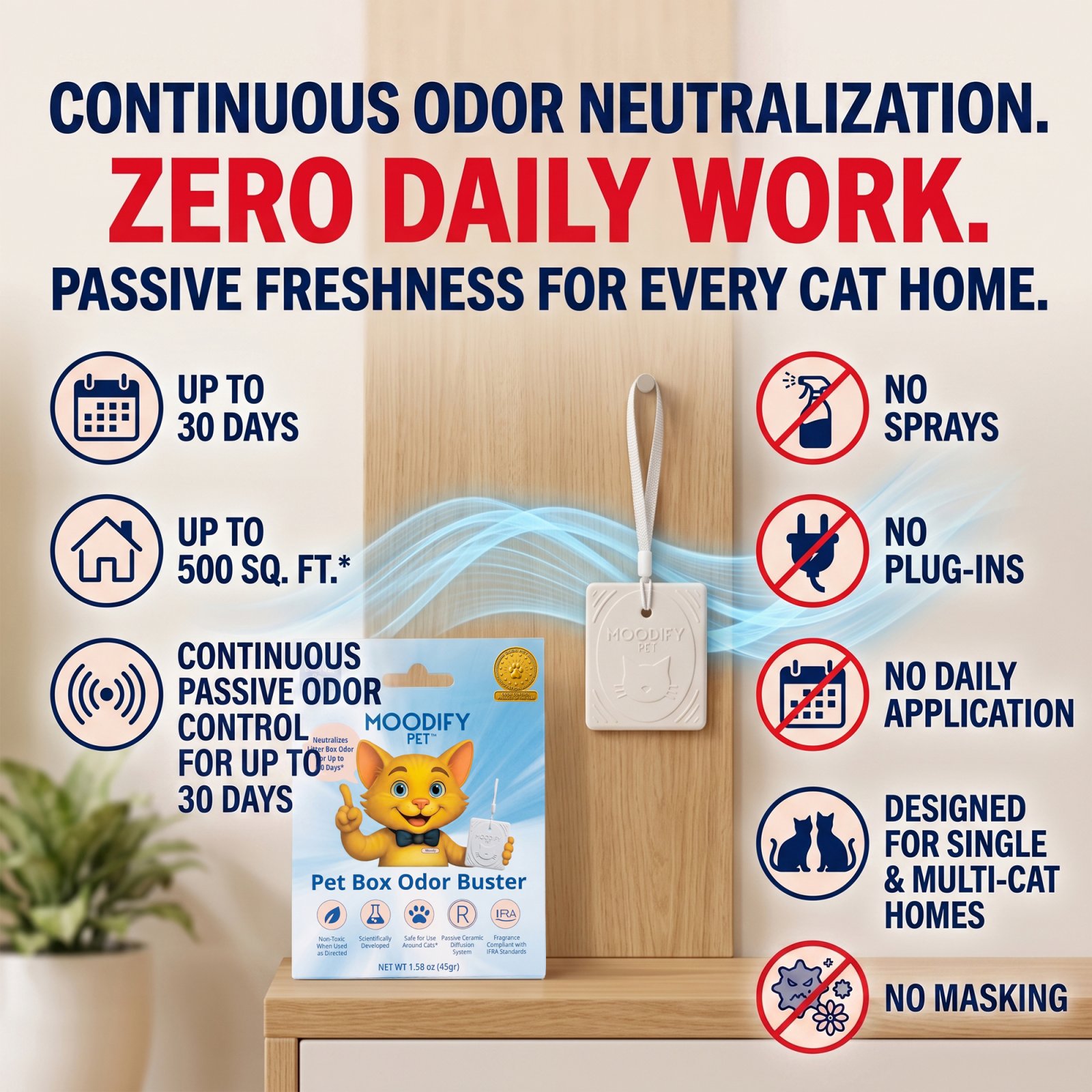
This is where an air-based approach helps. Our premium ceramic passive system hangs 4-6 feet above the litter area and neutralizes odor molecules in the surrounding air rather than inside the litter. For the full breakdown, read our guide on getting rid of cat litter box smell.
Pick the Cleaner That Fits Your Routine
The right choice between Nature's Miracle and Rocco Roxie depends on your household, not on which is "better" in a vacuum.
- Choose Nature's Miracle if you have multiple pets, deal with deep-set stains regularly, and don't mind a stronger scent during cleaning.
- Choose Rocco Roxie if you have a sensitive nose, a single cat, and mostly need spot treatment on fresh spills.
- Skip both for routine odor control if your main complaint is lingering smell in the air around a clean box. Enzymatic cleaners treat surfaces, not the air.
That last point is the one most guides miss. Enzymatic cleaners are excellent at what they do, but they don't address the odor that spreads through a room between cleanings. For that, a passive air-based system is the better fit. How MoodifyPet works explains the science behind the system and why it is safe around cats, kids, and you. Our premium ceramic passive system covers up to 30 days per unit with no sprays or daily steps.
Frequently Asked Questions
Is Nature's Miracle or Rocco & Roxie better for pet urine?
Both are enzyme-based cleaners, so the better pick depends on the job. For deep-set stains, choose whichever enzymatic cleaner you can saturate fully and leave for the full dwell time listed on its label. Neither replaces routine scooping or litter changes.
Do Nature's Miracle and Rocco & Roxie use enzymes?
Yes. Both rely on enzyme and bacterial action to break down the organic matter in urine rather than just covering it with fragrance. That is why dwell time matters: the formula needs to stay wet long enough for the enzymes to work. Wiping immediately after spraying cuts the process short and leaves odor compounds behind. Check the label on the specific bottle you buy, since formulas vary by product line.
Can you use Rocco & Roxie on carpets and upholstery?
Enzymatic cleaners are commonly used on carpets, rugs, and upholstery. Test on a hidden patch first, especially on wool, silk, or anything labeled dry-clean only. Blot rather than scrub, and let the surface dry fully before judging the result. For old cat urine smell from carpet, a second application after the first dries is often needed.
Are enzymatic cleaners safe to use around cats?
Enzymatic cleaners are generally safe when used as directed on the label, but the key is letting treated surfaces dry completely before your cat walks on them or grooms. Keep cats out of the room during application and ventilation. Store bottles out of reach, and never mix cleaners with other household products. If your cat has health issues or you are treating a surface your cat licks, ask your veterinarian first.
If you've tried every enzymatic cleaner and the smell still lingers, the problem may not be the product. It may be the air. MoodifyPet's premium ceramic passive system neutralizes litter box odor in the surrounding air, covers up to 500 square feet, and lasts up to 30 days per unit with no batteries or sprays. Get started with MoodifyPet and give your home a cleaner, more neutral baseline between cleanings.
