 Hollywood Feed


Last Updated: October 26, 2026
Quick Summary
Litter odor control belongs above the box, not inside it. Odor molecules rise with warm air and spread through the room, so the most effective spot for a litter odor control device is a wall 4 to 6 feet above the litter area, in the same room, with clear air between the two.
- Air-based systems work on the room, while baking soda and powders work inside the box on contact.
- Score each candidate room on ventilation, noise, privacy, access, and traffic; 18 or higher is strong.
- Avoid placing the box in sealed closets, garages, high-traffic hallways, or beside heating vents and drafts.
- In apartments, hang odor control above the box, not across the room, and scoop twice daily.
- Separate multi-cat boxes by sightline so no two boxes are visible from each other.
Table of Contents
- The Short Answer: Where Litter Odor Control Belongs
- Where to Put Cat Litter Deodorizer So It Actually Works
- Choosing a Litter Box Location: Quiet, Accessible, Ventilated
- Room-by-Room Placement Guide for Your Home
- Cat Litter Smell in Apartment Layouts: Working With Limited Space
- Automatic Litter Box Odor Control: Placement That Complements the Machine
- Multi-Cat Litter Box Odor Control: A Placement Plan for Every Box
- Ventilation Without Spreading Odor Through the House
- What Matters Most When You Set Up
- Frequently Asked Questions
The Short Answer: Where Litter Odor Control Belongs
Litter odor control belongs above the box, not inside it.
This guide covers room-by-room decisions, apartment layouts, multi-cat setups, and mistakes that undo good intentions.

Where to Put Cat Litter Deodorizer So It Actually Works
Air-based litter odor control works best in the path odor travels. Warm air carries litter odor upward and outward, so a device in that rising column intercepts odor before it spreads.
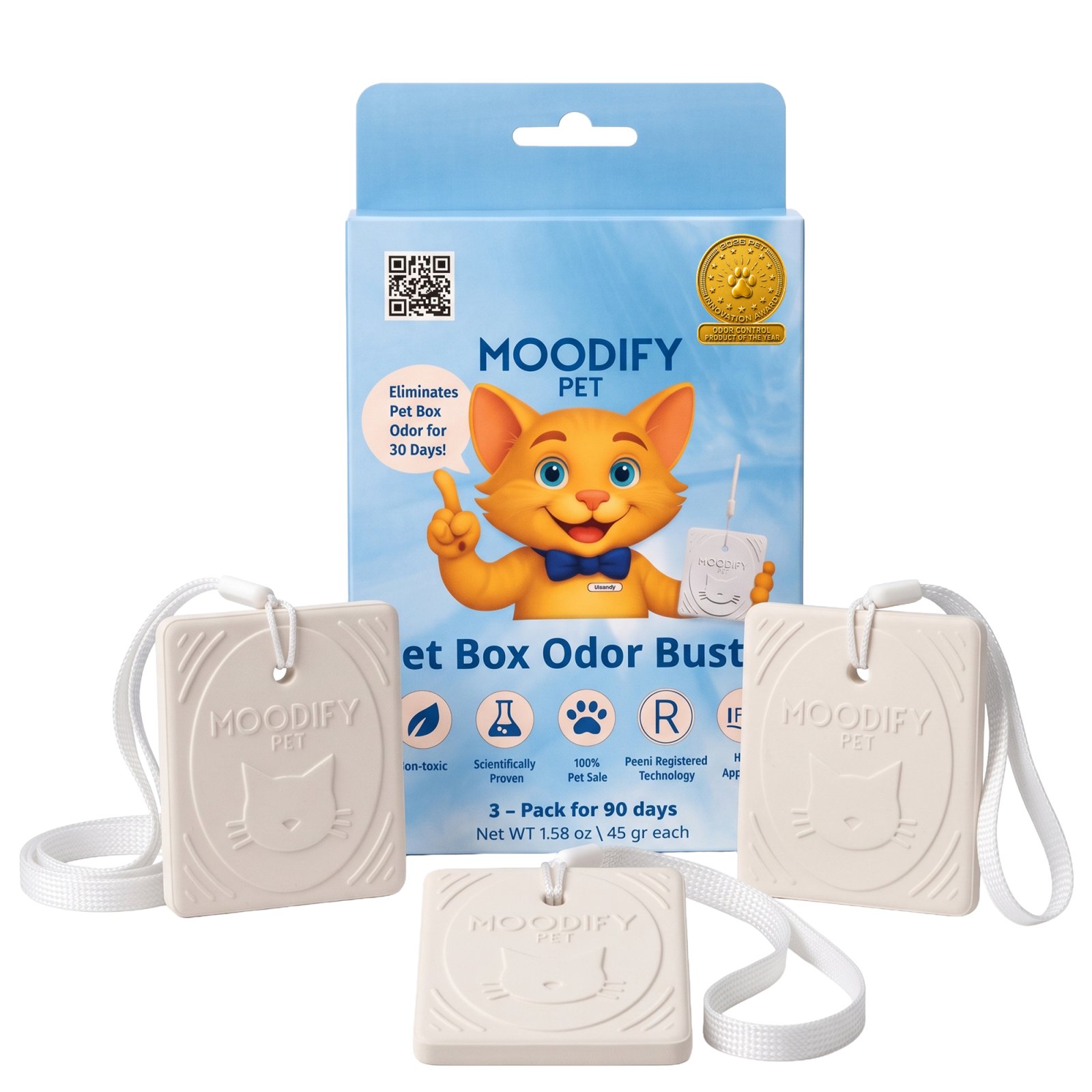
Our premium ceramic passive system hangs 4 to 6 feet above the litter area, never touching the litter or the cat.

Air-Based vs. In-Litter Products: Two Different Jobs
In-litter products and air-based systems solve different problems. Baking soda, odor-control litter, and powders work inside the box on contact. Air-based systems work on the room.
Here's how the options compare:
| Approach | Where It Works | Maintenance |
|---|---|---|
| Odor-control litter | Inside the litter | Full litter changes |
| Baking soda or powders | Inside the litter | Daily mixing |
| Carbon filters | Inside an enclosed box | Regular replacement |
| Sprays and plug-ins | Room air | Daily or ongoing use |
| Passive ceramic system | Room air above the box | Replace every 30 days |
Neither approach replaces the other. Scoop daily, change litter on schedule, and let an air-based system handle what escapes the box.
If you want a deeper comparison of filter-based and litter-based options, our guide to charcoal filter vs litter deodorizer covers where each one works and which setup fits your home.
Choosing a Litter Box Location: Quiet, Accessible, Ventilated
A good litter box location balances three needs: quiet, easy access, and airflow. Cats avoid boxes in loud, busy spots, boxes they can't reach quickly, and boxes where they feel exposed. Score each candidate spot against these three needs:
- Quiet: away from washer spin cycles, slamming doors, and foot traffic
- Accessible: a clear path the cat can use without being cornered
- Ventilated: some air movement, but not a direct draft
Placement Mistakes and Locations to Avoid
The worst spots share one trait: they trap or spread odor. Avoid these:
- Next to food and water. Cats dislike eating near their toilet, and odor drifts onto bowls.
- Inside a closed closet. Odor buildup is fast, and cats can feel trapped.
- In the garage. Temperature swings and fumes make it unpleasant.
A sealed closet is the most common mistake: odor has nowhere to go, so it soaks into clothing and walls.
Room-by-Room Placement Guide for Your Home
Every room trades off five variables: ventilation, noise, privacy, access, and household traffic. The best location maximizes access and privacy while keeping noise and traffic low and airflow gentle. Ratings below are relative.
| Room | Ventilation | Noise | Privacy | Access | Traffic | Best For |
|---|---|---|---|---|---|---|
| Bathroom | Moderate (exhaust fan) | Low | High | Good | Low | Most homes; default choice |
| Laundry room | Good when door is open | High during cycles | High | Good | Low | Homes with a door that stays cracked |
| Spare bedroom | Moderate | Low | High | Good | Low | Quiet households, anxious cats |
| Basement | Low unless conditioned | Low | High | Fair (stairs) | Low | Mild, dry climates only |
| Living room corner | Good | Moderate | Low | Excellent | High | Small apartments with no alternative |
| Garage | High but uncontrolled | Moderate | Moderate | Fair | Low | Not recommended in most climates |
| Closed closet | Very low | Low | Very high | Poor | Low | Not recommended, traps odor |
How to Score a Room in Under Five Minutes
Walk into each candidate room and answer five questions on a 1-5 scale:
- Ventilation: Does air move through the room without a fan pointed at the floor? (1 = sealed, 5 = gentle cross-breeze)
- Noise: Can you hear appliances, doors, or street noise from the box spot? (1 = constant noise, 5 = silent)
- Privacy: Can the cat see the approach and exit without crossing an open area? (1 = exposed, 5 = sheltered sightlines)
- Access: Is there a clear, short path from the cat's main resting area? (1 = stairs and doors, 5 = direct)
- Traffic: How often do people pass within a few feet? (1 = constant, 5 = rare)
Any room scoring 18 or higher is a strong candidate. Rooms scoring 12-17 are workable with adjustments, a cracked door, a privacy screen, or an air-based odor control system above the box. Rooms below 12 usually create more problems than they solve.
Room-by-Room Trade-Offs
Spare bedroom. Quiet and private, which anxious cats appreciate.
Living space. Workable only if the box sits in a corner away from seating and the main walking path.
Basement. Fine in mild, dry climates, but check temperature and dampness first, cats may avoid cold, damp rooms.
Garage. Generally not recommended: temperature swings, fumes, and distance from living areas make garages unpleasant for most cats.
Floor-Plan Examples
One-bedroom apartment. Bathroom is the default. If the bathroom is too small, use a living-room corner with a privacy screen and hang odor control above the box.
Two-story home. One box per floor, the primary in an upstairs bathroom or spare bedroom, the secondary in a downstairs laundry room or bathroom.
MoodifyPet Cat Litter Box Odor Neutralizer — 1 System for 30 Days →
Multi-cat home with a dedicated cat room. A spare bedroom works well as a central box room, but only if boxes are spread within it rather than clustered.

Cat Litter Smell in Apartment Layouts: Working With Limited Space
Small apartments concentrate odor fast. A studio or one-bedroom has fewer air exchanges, so litter box smell builds instead of dispersing.
- Put the box as far from sleeping and eating areas as the floor plan allows
- Keep a clear path to the box so your cat isn't crossing your bed or kitchen
- Use a covered box only if your cat accepts it, since covers trap odor
One system covers up to 500 square feet, which suits most apartment layouts. For a focused walkthrough, read our guide on how to eliminate litter box odor in a small apartment.
Automatic Litter Box Odor Control: Placement That Complements the Machine
Automatic boxes handle scooping, not room air. Odor still escapes every time the machine cycles or your cat leaves the box.
Placement rules for automatic units:
- Give the unit a level, dry spot with clearance on all sides.
- Keep it out of closets and tight corners where odor collects.
- Plug it in away from water sources.
- Hang air-based odor control above the unit, not on it.
- Empty the waste drawer on the schedule the maker recommends.
A passive system pairs well with automatic boxes because it needs no outlet and no daily input. Replace it every 30 days and the machine keeps doing its job.
Multi-Cat Litter Box Odor Control: A Placement Plan for Every Box
More cats means more boxes, and more boxes means a placement plan. The usual guidance, one box per cat plus one extra, spread across the home, is a starting point, not a plan. What most guides miss is how to distribute boxes so cats actually use them and how to scale odor control to match.
Why Clustering Boxes Backfires
Cats are territorial about elimination space. When boxes sit side by side, a confident cat can guard the cluster and shyer cats may avoid the area entirely, sometimes eliminating outside the box. Clustering also concentrates odor in one spot, overwhelming any single odor-control device. Spreading boxes solves both problems at once.
A Distribution Method That Works
Use this sequence to plan box placement for two, three, or four cats:
- Count boxes. One per cat plus one. Two cats = three boxes; three cats = four boxes.
- Map cat territories. Note where each cat rests, eats, and spends most of the day. Boxes should be reachable from those areas without crossing another cat's core territory.
- Assign one box per zone. Divide the home into zones, upstairs, downstairs, front, back, and place at least one box in each zone where a cat spends time.
- Separate boxes by sightline. No two boxes should be visible from each other. A cat using one box should not be able to see another cat approaching a second box.
- Keep escape routes open. Each box needs two exits or a clear line of sight to an exit so a cat is never cornered.
- Match odor control to boxes. Hang one passive system above each box, or one per room if boxes share a room and the room is under 500 square feet.
Scaling Odor Control to the Home
A single passive system covers up to 500 square feet. In a multi-cat home, match coverage to the number of odor sources, not just square footage.
| Household | Boxes | Suggested Odor Control |
|---|---|---|
| 2 cats, apartment under 500 sq ft | 3 | 1 system above the primary box, or 1 per room if boxes are split |
| 2 cats, home 1,000-1,500 sq ft | 3 | 2 systems, one per box zone |
| 3 cats, home 1,500-2,000 sq ft | 4 | 2-3 systems, one per zone or per box |
| 4+ cats, multi-story home | 5+ | 1 system per box or per room, replaced every 30 days |
A 3-pack covers 90 days for a single box, or 30 days across three boxes. Multi-cat homes typically replace systems on a rolling schedule so coverage never lapses.
Behavior Troubleshooting
If a multi-cat home still has odor problems after spreading boxes, the cause is usually one of these:
- One cat is guarding a box. Add another box in a different zone and separate sightlines.
- A box is too small for the largest cat. Boxes should be about 1.5 times the length of the cat.
- A box is in a dead-end space. Move it to a spot with two escape routes.
A Multi-Cat Placement Checklist
- One box per cat plus one, spread across zones
- No two boxes visible from each other
- Two exits or a clear escape route per box
For a deeper look at sizing and coverage, our guide to multi-cat litter box odor solutions walks through the details. If you are also managing an automatic box alongside traditional ones, the placement rules in the automatic litter box section above apply to each unit.
Ventilation Without Spreading Odor Through the House
Airflow cuts odor, but the wrong airflow spreads it. A fan pointed at the box, or an open window beside it, pushes litter dust and odor into the next room.
The goal is gentle exchange, not a wind tunnel:
- Crack a window in the box room, not beside the box
- Run a bathroom exhaust fan for short bursts
- Keep interior doors open so air moves without a direct path to living areas
Placement and ventilation work together: odor molecules rise, and air-based litter odor control above the box handles them before they travel. Our explainer on why litter box odor spreads through the air shows how that movement works.
What Matters Most When You Set Up
Placement is the lever most owners never pull. Get the height right, keep the box quiet and accessible, and add air-based control above it. Then scoop daily and change litter on schedule.
MoodifyPet's premium ceramic passive system hangs 4 to 6 feet above the litter area, needs no batteries or sprays, and lasts up to 30 days. It works alongside your cleaning routine, not instead of it. Multi-cat homes can use the 3-pack to cover several boxes at once.
Frequently Asked Questions
Should litter odor control go inside or outside the litter box?
It depends on the product. Powders and litter additives go inside the litter, while air-based systems hang outside and above the box, typically 4 to 6 feet up. Mixing the two is fine: in-litter products handle the litter itself, and an air-based system like MoodifyPet's premium ceramic passive system works on odor molecules in the surrounding air. Never place an air-based unit inside the box where it can contact litter or your cat.
Where should you place odor control in a small apartment?
Put the box in the least-trafficked spot with real airflow, often a bathroom or a corner of a bedroom away from the kitchen. Hang air-based odor control 4 to 6 feet above the box so it covers the surrounding air, and keep the door cracked when you can. A single MoodifyPet system covers up to 500 sq. ft., which suits most apartment layouts when paired with daily scooping and regular litter changes.
How can you reduce litter box odor in a multi-cat home?
Start with enough boxes: the common rule is one per cat plus one extra, placed in separate locations rather than lined up together. Scoop at least once a day, change litter on schedule, and add air-based odor control above each box area. MoodifyPet's 3-pack covers up to three litter boxes for 30 days, or stretches one box to 90 days, which fits most two- to three-cat households.
Where should you not put a litter box?
Skip the garage, basement, and closet: these spots are often too hot, too cold, damp, or sealed off from airflow, and a cat may avoid them entirely. Keep boxes away from food and water bowls and out of loud, high-traffic areas like a laundry room mid-cycle. A box your cat avoids gets used elsewhere in the house, which creates a bigger odor problem than the original placement.
If litter box smell keeps winning in your home, start with placement. Move the box to a quiet, ventilated spot, hang odor control above it, and give it 30 days. MoodifyPet's passive ceramic system covers up to 500 square feet with no sprays, plug-ins, or daily steps. Get started with MoodifyPet and give every room in your home a cleaner, more neutral baseline.
