 Hollywood Feed

Table of Contents
- What Makes a Litter Box Deodorizer Non-Toxic
- How Non-Toxic Odor Neutralizers Work
- Litter Box Deodorizer Without Baking Soda: Alternative Approaches
- Best Non-Toxic Deodorizers for Multi-Cat Litter Box Odor Control
- Automatic Litter Box Odor Control: Non-Toxic Options
- Cat Litter Smell in Apartment: Space-Efficient Solutions
- Comparison Table: Non-Toxic Deodorizer Options
- Safety, Cost, and Performance Considerations
- Frequently Asked Questions
Last Updated: October 16, 2026
What Makes a Litter Box Deodorizer Non-Toxic
"Non-toxic" is not a regulated term on pet product labels, so two products with the same claim can differ greatly. The useful question isn't "is it natural?" but "what is in it, how does it reach my cat, and how much exposure is realistic?"
In practical terms, a non-toxic litter box deodorizer controls odor without introducing ingredients at concentrations or exposure routes known to harm cats, a definition with three parts: ingredient list, exposure route, and dose.
Start With the Ingredient List, Not the Marketing
Scan for these categories, because they drive most cat-safety concerns:
- Essential oils and terpenes. Tea tree, eucalyptus, citrus, peppermint, pine, and wintergreen contain compounds cats metabolize poorly. Cats lack efficient glucuronidation pathways in the liver, a well-documented species difference that leads veterinary toxicology references to flag many essential oils as risky around cats.
- Phenols and phenolic compounds. Found in some pine-based and "natural" cleaners and deodorizers; cats are notably sensitive to phenols.
- Aerosol propellants and fine particulates. Sprays and dusts put ingredients into the air your cat breathes and onto paws your cat grooms.
A product that discloses its fragrance source and confirms compliance with International Fragrance Association (IFRA) standards gives you more to work with than one that simply says "pet safe." IFRA standards cover human exposure, not cats, so treat compliance as a transparency signal, not proof of feline safety.
Match the Exposure Route to Your Cat's Behavior
Cats interact with deodorizers in three main ways, and the route matters as much as the ingredient:
- Ingestion and grooming. Powders and additives in the litter stick to paws and fur; a cat that grooms after using the box swallows whatever it picked up. This is the highest-risk route for litter additives.
- Inhalation. Sprays, aerosols, and fine dust put particles into the air. Cats have small lungs and spend hours a day at floor level where heavier particles settle.
- Contact. Gels, liquids, and treated surfaces can be brushed against or licked.
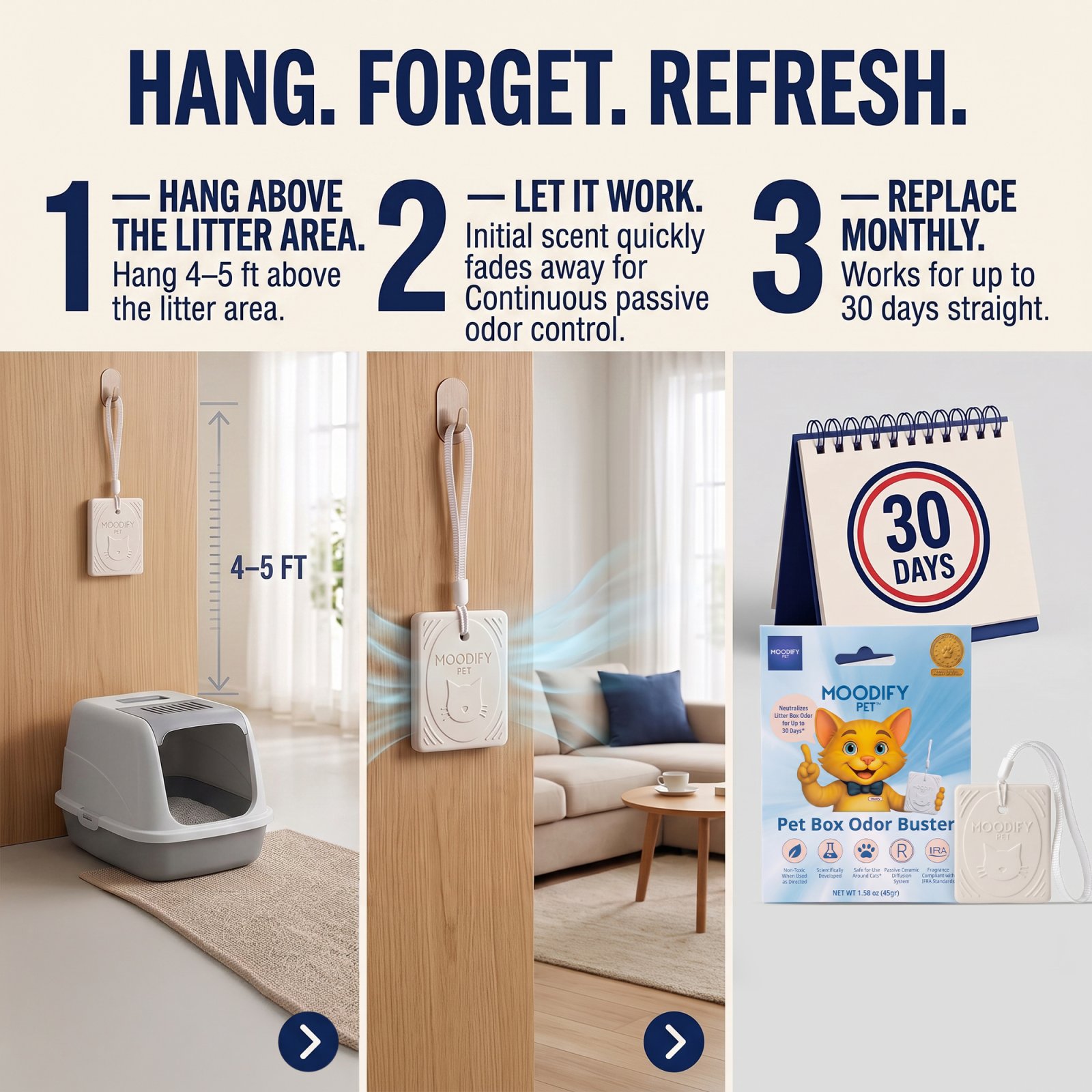
A deodorizer that never touches the litter and never enters the air as a spray removes the ingestion and contact routes entirely, the design logic behind passive, air-based systems such as MoodifyPet, which hang 4-6 feet above the litter area and work in the surrounding air rather than inside the litter.

Use a Simple Screening Checklist
Before you buy, run any product through these questions:
- Does the label list specific ingredients, or only a category like "fragrance"?
- Does it contain essential oils, phenols, or aerosol propellants?
- Does it go into the litter, into the air as a spray, or into the surrounding air passively?
A product that answers all five clearly is easier to trust than one that answers none. "Natural" is not a synonym for safe, several of the most cat-toxic substances in a home are plant-derived, and "synthetic" is not automatically unsafe. Ingredient identity, exposure route, and dose are what matter.
How Non-Toxic Odor Neutralizers Work
Non-toxic odor neutralizers work through two primary mechanisms: absorption and molecular neutralization.
The most effective non-toxic deodorizers combine both approaches. MoodifyPet, for example, uses fragrance-infused porous ceramic with catalyst technology that neutralizes odor molecules in the surrounding air rather than masking them with stronger scents.

This distinction matters in multi-cat households or apartments where odor builds quickly. A masking product feels effective for a few hours, then fades; a true neutralizer keeps working for weeks because it addresses the root cause, not the symptom.
Litter Box Deodorizer Without Baking Soda: Alternative Approaches
Baking soda has long been the default recommendation for litter box odor, but it has real limitations.
Enzymatic additives break down the compounds that create ammonia smell.
Ventilation and air purification tackle the problem at scale, a dedicated exhaust fan or HEPA air purifier removes odor particles from the entire space.
Passive ceramic odor neutralizers like MoodifyPet offer a middle ground: they neutralize odors in the surrounding air without powders, sprays, or maintenance.
Best Non-Toxic Deodorizers for Multi-Cat Litter Box Odor Control
Multi-cat odor is not just "more" odor, it is a different problem. The standard rule of thumb is one litter box per cat plus one extra, so a two-cat home should have three boxes and a three-cat home four. More boxes means more odor-producing surface area, more litter to maintain, and more places for smell to build up between cleanings.
MoodifyPet Cat Litter Box Odor Neutralizer — 1 System for 30 Days →
The right approach depends on which format you choose. Here is how the main non-toxic options compare for multi-cat households.
Format-by-Format Comparison for Multi-Cat Homes
Litter additives (enzymatic or mineral powders). These go into the litter and target ammonia and organic compounds at the source.
Activated charcoal filters. Passive and inexpensive, but each filter covers a small area and needs frequent replacement.
Sprays and aerosol air fresheners. Fast-acting but short-lived, and they put fragrance and propellants directly into the air.
Ventilation and air purifiers. Effective at clearing a whole room and a good complement to any deodorizer.
Passive air-based neutralizers. These hang above the litter area and work in the surrounding air without touching the litter or requiring daily input.

Match the Deodorizer to Your Litter Type
Litter type changes how well each format performs:
- Clay clumping litter. Dense and low-dust when quality is good. Additives mix in evenly; passive air units work well because the box itself doesn't release much airborne dust.
- Pine and wood pellets. Strong natural odor, and the pellets break down into sawdust. Additives can clump awkwardly with sawdust; passive air units avoid that problem entirely.
- Paper and recycled paper litter. Low dust and low tracking, but weaker natural odor control, so airborne deodorizing matters more.
If you use more than one litter type across boxes, a passive air-based deodorizer works the same way regardless of what is in each box.
Household Math: How Many Units Do You Actually Need?
Coverage depends on three variables: number of boxes, room size, and airflow. A practical starting point:
- One cat, one box, small room. One passive unit above the box.
- Two cats, two to three boxes, one room. One passive unit covering the room, positioned 4-6 feet above the boxes.
- Three or more cats, boxes in multiple rooms. One unit per room where boxes live, since a single unit cannot cover odors across separate closed spaces.
MoodifyPet is designed for up to 30 days of passive odor control per unit, and Subscribe & Save replacement options make the monthly cadence easier in a multi-cat home where you already replace litter and clean boxes on a schedule.
What Multi-Cat Owners Get Wrong
The most common mistake is buying one strong product and expecting it to cover every box. Odor control in a multi-cat home is a system: scoop at least once daily (twice with three or more cats), change litter on schedule, wash boxes monthly, ventilate, and add an air-based deodorizer for odors maintenance alone cannot catch.
A second mistake is ignoring box placement. Boxes clustered in one small closet concentrate odor; spreading them across rooms reduces peak concentration but requires coverage in each location. Passive units make that easier because there's no daily application to keep up with.
Feline house-soiling and litter box management guidance
Cat owner resources on litter box care
Automatic Litter Box Odor Control: Non-Toxic Options
Automatic litter boxes reduce odor by removing waste immediately after cats use them, but they don't eliminate smell entirely.
For automatic litter box owners, pairing the system with a passive air-based deodorizer is the most effective approach.
MoodifyPet Cat Litter Box Odor Neutralizer — 1 System for 30 Days →
Automatic boxes also benefit from good ventilation. If your setup is in a closed room or corner, crack a window or run a small exhaust fan during peak usage times so odors don't concentrate in a confined space.
Cat Litter Smell in Apartment: Space-Efficient Solutions
Apartment living makes litter box odor control critical because you have limited space and can't install permanent ventilation.
Start with a passive air-based deodorizer placed strategically.
Pair this with good hygiene: scoop twice daily, change litter weekly, and wash the box monthly.
For renters, passive systems like MoodifyPet are ideal because they require no installation, no holes, and no damage to walls or vents.
Comparison Table: Non-Toxic Deodorizer Options
| Solution | Type | Coverage | Duration | Best For | Maintenance |
|---|---|---|---|---|---|
| MoodifyPet 1-System | Passive ceramic | 1 litter box | 30 days | Single-cat homes, trials | Replace monthly |
| MoodifyPet 3-Pack | Passive ceramic | 2-3 boxes or 1 box | 30-90 days | Multi-cat homes | Replace units as needed |
| MoodifyPet 6-Pack | Passive ceramic | Whole-home or 6 months | 30-180 days | Large multi-cat homes | Replace units as needed |
| Enzymatic litter additive | Chemical breakdown | 1 litter box | 1-2 weeks | Odor reduction in litter | Add weekly |
| Activated charcoal filter | Absorption | 1 litter area | 2-4 weeks | Budget-conscious owners | Replace frequently |
| Ventilation/exhaust fan | Air circulation | Entire room | Continuous | Permanent solution | Minimal (filter cleaning) |
Safety, Cost, and Performance Considerations
When choosing a non-toxic litter box deodorizer, balance three factors: safety, cost, and how well it controls odor in your specific space.
Safety means the product contains no essential oils, aerosol propellants, or synthetic chemicals that accumulate in your cat's environment.
Cost varies depending on whether you choose a one-time purchase or ongoing replacements.
Performance depends on your space.
The most common mistake is expecting any single product to eliminate odor completely without regular scooping and litter changes.
Persistent litter box odor often signals that your current approach isn't matching your household's needs. Start with a single system to test the fit, or choose a multi-pack if you have multiple cats. Shop MoodifyPet now and see the difference a truly non-toxic approach makes.
Frequently Asked Questions
How do I know a non-toxic litter box deodorizer actually neutralizes odors instead of just masking them?
True odor neutralizers work by breaking down odor molecules at the source, not covering them with fragrance. Non-toxic options use catalyst technology or porous materials that absorb and neutralize ammonia and fecal odors. MoodifyPet uses catalyst technology to neutralize odor molecules in the air surrounding your litter box, rather than simply masking smells. You may notice the fragrance becomes less noticeable after 24-72 hours, but that doesn't mean odor control has stopped, it's working passively in the background.
Are non-toxic litter box deodorizers safe for cats to be around every day?
Yes, when used as directed. Non-toxic deodorizers are specifically formulated to be safe around cats without direct contact. MoodifyPet is non-toxic, IFRA-compliant, and designed to hang 4-6 feet above the litter area, keeping it away from your cat while still controlling odors in the surrounding air. Always verify that any product you choose is labeled safe for pets and follow placement instructions carefully. If your cat has respiratory sensitivity, consult your veterinarian before introducing any new product.
How long does a non-toxic litter box deodorizer last, and when should I replace it?
Most non-toxic deodorizers last 30 days of continuous odor control. MoodifyPet systems provide up to 30 days of passive odor neutralization per unit before replacement. For single-cat homes, one unit covers one litter box monthly. Multi-cat households may need multiple units or more frequent replacement depending on the number of cats and litter boxes. Subscribe & Save options make it easy to schedule automatic replacements every 30 days so you never run out.
Can I use a non-toxic litter box deodorizer in an apartment or small space?
Absolutely. Non-toxic deodorizers are ideal for apartments because they require no electricity, sprays, or plug-ins, just passive placement. MoodifyPet is designed for spaces up to 500 sq. ft. and hangs discreetly above the litter box without taking up floor space. In apartments where odor travels quickly, proper placement 4-6 feet above the litter box and regular scooping together create the most effective odor control without disturbing neighbors or adding chemical smells to shared ventilation.
What's the actual cost difference between non-toxic deodorizers and other odor-control methods?
Non-toxic passive deodorizers like MoodifyPet cost $24.99 for one 30-day system, making the monthly cost straightforward and predictable. Multi-cat packs offer better value: the 3-pack ($74.97) covers three boxes for 30 days or one box for 90 days. Compare this to ongoing purchases of enzymatic additives, sprays, or activated charcoal filters, which require frequent rebuying. Passive systems eliminate the need for daily applications and provide consistent odor control without ongoing maintenance costs.